**I was asked to write an article for Active Trader Magazine, and I submitted the article below this week for an upcoming issue. I couldn’t imagine not sharing it with Bandits first though, so here you go!
Trading the Slingshot
For some strange reason as a kid, I collected a variety of unusual weapons ranging from butterfly knives to Chinese stars to a blow dart gun. However, my favorite was the arm-braced aluminum slingshot with the medical rubber tubing and leather pouch. When exploring the outdoors with my friends, I just knew I was prepared for any critter threat which might possibly come along.
Trading is much the same way in that we must be prepared for anything. The market presents many dangers and opportunities for us, so when we’re exploring ideas among the charts, it’s imperative that we’re equipped with some quality trading weapons.
A setup I’ve discovered recently is one I’ve dubbed “The Slingshot.” It’s a hybrid version of the rounded low pattern, but rather than the gradual reversal which tends to emerge from saucer-like lows, the Slingshot has potential for some explosive upside moves when certain conditions are present. So in this article, we’ll examine the traits which set this pattern apart.
Roots in the Rounded Low
Technical patterns often resemble each other, and that’s the case with “The Slingshot” as compared to the Rounded Low. They do retain their own traits, however, so I’ll clarify the distinctions between them.
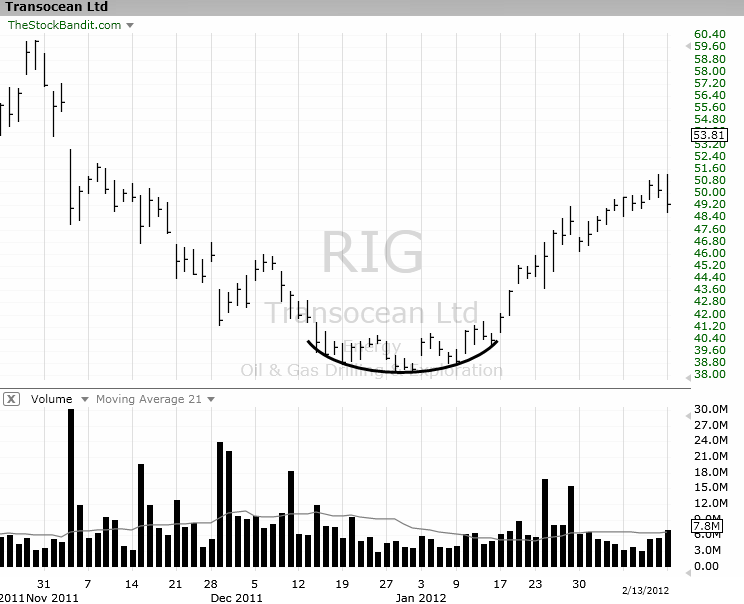
A steady decline in RIG was followed by a slow shift of direction with the gradual creation of a multi-week rounded low into early 2012. This pattern produced an upside reversal, but it's a longer-term type of play as compared to The Slingshot.
The Rounded Low, or Saucer pattern represents a slow shift of direction from down to up. Generally, these patterns emerge after a meaningful correction (see RIG chart for Rounded Low example). The pace of the decline in price steadily slows to equilibrium, creating the left and center portions of the pattern as sellers gradually exhaust themselves and recognize (at least temporarily) that the correction has ended.
As buyers timidly enter the picture again, the right portion of the pattern mirrors the left with a gradual lift in price. Once completed, this pattern represents a half-circle, although usually flatter in appearance – much like a saucer. Price has slowly turned higher after the selloff, and upside momentum becomes a possibility again. The shift of direction in price reflects the mood shift which is also underway, changing the path of least resistance from down to up.
“The Slingshot” could be considered a relative of the Rounded Low. Think of it as a younger, faster-moving, and more temperamental version of the rounded low as we get into this explanation. It’s essentially a compressed version of the saucer, meaning it happens in less time and with stronger emotions, but generates a similar rounded appearance over the course of several bars on the chart.

A multi-day selloff was met with a few days of indecision in late-December. A push through resistance at $13.10 produced some initial strength, a brief test two days later, then excellent follow through.
Referring to it as “The Slingshot” only makes sense. When you think of stretching back the bands of a slingshot, they tend to stop at a point where they just can’t give much more before snapping back. Pulling back the pouch, you hold it momentarily before letting it go, which of course brings about a shift of direction for the object.
This is that kind of trade.
“The Slingshot” setup is found in a stock which has swiftly declined to the point at which it has become short-term stretched. That move is then followed by a brief pause of perhaps only a couple of bars, which then opens the door for a potential snap-back move to the upside. This play produces a faster 180-degree reversal than the saucer pattern, making it more of a momentum trader’s type of setup.
Psychology in Motion
The element of emotions and psychology are what tend to make “The Slingshot” pattern so appealing. Specifically, it’s the presence of fear in all who are involved during the latter part of this play which gives it such potential for a sharp rebound. Let’s examine the thought process of both bulls and bears along the way for greater insight.
The bulls are long, so a swift decline in price alerts them to danger. Whether it’s open profits they are giving back or simply seeing losses mount, the result is the same: fear. This spooks holders of the stock out of their positions, thereby accelerating the pace of the selling.

The mid-summer decline was harsh, but the stock was able to rest for a week, creating both a defined short-term resistance level as a pivot to buy and a rounded look. A multi-day high provided the pivot for entry at $14.90.
The bears identify the pervasive weakness and aggressively short the stock, sensing opportunity to snag some quick gains. Their profits grow rapidly until the pace of the move slows, which puts them on alert for a potential bounce or reversal.
Both camps to this point have been sellers, which produces the momentum for the swift decline we’re looking for.
As equilibrium is found and the selloff abates, both parties begin to second-guess their recent sales. Bears are now apt to cover their shorts whenever some strength appears, fearful that they’ll surrender easy profits if they overstay their welcome. Alternately, the same bulls who previously jumped ship on the way down are now fearful of missing the boat if the correction is over, so they begin to sense an opportunity to get back in.
This combination of bulls and bears becoming buyers, at least temporarily, is what can produce the rapid shift of direction for higher prices. It’s an emotional trade which is intensified by the tendency of both bulls and bears to take the same actions at the same time – something we don’t see often.
The Specifics of the Play
Now that we have a more thorough understanding of what the play involves and what tends to make it work so well, let’s get more specific. We’ll examine each of the characteristics of the setup in order to identify it properly and execute it with a higher probability of success.
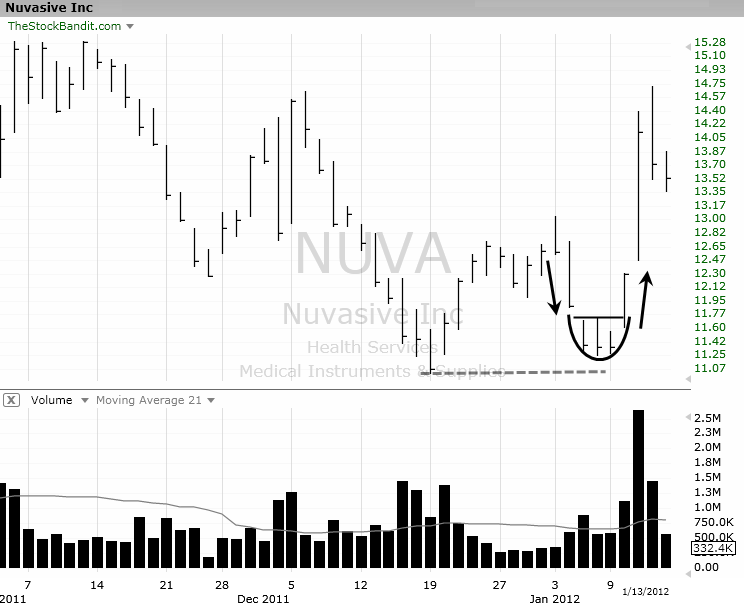
Several days of selling resulted in price finishing for three consecutive days in the same area, showing equilibrium between buyers and sellers. As price reversed higher to make a multi-day high through $11.80, volume ramped higher and a rapid ascent in price followed.
While this play can be applied to any timeframe, I’ll use daily charts as examples for the sake of consistency throughout this explanation.
Decline. The selloff which creates the first portion of this setup occurs over the course of multiple bars. What we want to watch for are several days of actual selling, not just a big single-day decline or a big gap lower. There must be some emotion involved here which has the bulls on the run, and their disappointment is more prevalent when they’ve endured several days of nonstop selling. The decline must also be relentless, which is to say there are no bounces or advances during the down move – we want to see red bar after red bar as this play begins to set up.
Generally, I’m looking for at least a 3-day selloff with price shedding 8% or more. A longer-lasting decline with a deeper discount in price simply means greater emotion, but that’s my minimum. It’s perfectly fine if this setup corresponds with a multi-day market pullback as well, because the psychology will still be the same.
Rest. A pause in price is every bit as important as the nature of the decline which precedes it. We want to see the emotional selling followed immediately by a standstill as neither bulls nor bears know what to do next. This rest phase may only last from two to five bars – so it’s brief – but it’s a critical element of this setup. It indicates to us that now that emotions have diminished, temporarily, and opens the door for a shift of direction.
Reversal. Once the pause has completed, a multi-day high is the signal that price is reversing higher to clear the area on the chart where the rest phase occurred. This indicates that the shift of emotion and price is underway as the stock begins to retrace its recent descent.
Direction. “The Slingshot” is a long-only play for me. The reason for this is that stocks which have sold off sharply tend to produce more panic and emotion than stocks which have risen sharply. Stated otherwise, a sharp rally and then pause in price doesn’t tend to produce the downside reversal as often because different emotions are prevalent.
The rally-and-pause move promotes greed, as bears generally respect the strength and bulls desire to add to positions. The combination of selling by both parties after a big advance simply doesn’t often materialize when this is the case.
The decline-and-pause move, on the other hand, prompts two kinds of fear. The first is in bears who fear getting hurt on their short positions once the bounce begins, which makes them buyers. The second is in the bulls who fear missing the turn back up after dumping their positions on the way down. This produces simultaneous buying pressure, which is capable of making this a very lucrative play.
Execution. Entering “The Slingshot” is simple, but not always easy! The presence of emotion makes this a more volatile play, which can often mean a reduced position size is required in order to stay with the trade. I look to make my entry upon the establishment of a multi-day high as the rest phase is followed by initial strength. This is not an anticipatory entry, as I’m not buying within the rest phase. What I want to see is some strength emerging, which then prompts me to take action and buy. This is highly important, as a selloff followed by a rest phase can often bring downside continuation, so premature buys will often be costly.
That said, as price advances through multi-day resistance, it’s my signal that the retracement is beginning, so it’s time to buy. Ideally, I’m able to draw a lateral trend line to define that resistance zone, as depicted in the accompanying example charts. Trend lines help me be decisive, and offer me a timing mechanism for when to take action. As that level is crossed, I use a market buy order to get long, as I would rather catch the move and possibly pay up a few cents from my intended entry than to miss the play entirely. I then set a stop loss at a multi-day low, should the stock happen to turn lower once again. This protects my downside, giving me a well-defined risk zone from the outset of the trade.
Objective. While some “Slingshot” plays result in a complete retracement of the initial decline, that cannot be expected in every case. I am looking for a multi-day advance, but how long I’ll stay with the trade is going to depend on the presence of momentum. No two trades are exactly alike.
As price begins to gather momentum, I’ll look to scale out with partial exits, as is my trading style. Generally, I’ll look for a rebound in price beyond the trend line to reclaim at least half of what was given back in the initial decline before closing out part of my position. This allows me to book some gains along the way and make them real, while staying with a portion of my position should the move happen to continue. Once that objective is met, I’ll reduce my position, tighten my stop, and then manually trail my stop nightly to the prior day’s low in order to capture as much of the move as I can.
Final Reminders
We’ve covered a lot of ground with “The Slingshot” pattern, but allow me to offer a couple of final reminders as you head to the charts in search of this play.
First, this is not a pattern likely to be found every day, so consider it to be one play in your arsenal. The market demands that we’re prepared and equipped to utilize a variety of plays, so naturally we must be willing and able to modify our approach based upon the general conditions which are present at any given time. “The Slingshot” is more rare than many types of plays, which is one reason it has the potential to be so rewarding.
Second, trading “The Slingshot” isn’t about stepping out in front of excessive weakness and buying arbitrarily in hopes of catching a rebound. Truth be told, that’s a great way to self-destruct. Rather, “The Slingshot” is about waiting for price to pause after a big decline and meet some temporary point of equilibrium. Then the signal to act comes once the tide begins to shift with a turn higher.
“The Slingshot” setup not only offers us an up-close look at the emotions which are present in the market, but also a short-term opportunity to capitalize on those same emotions. Learn this play and watch for it, as it’s a great addition to the classical patterns you may already be trading.