


My ‘Don’t Be a Monkey‘ post prompted some discussion on how to view losses, so I just want to explore that idea a little further. Specifically, Eric commented ‘learn to love loss, and you are on your way.’
Love might not be my chosen word for it, but yeah, that’s the idea. Put it this way…
Last year, we were house hunting with our realtor. When we’d pull up in front of a house that just wasn’t at all our style, we’d offer a preventive “next” to save us all the time of going through a house we just didn’t envision actually buying.
You can’t judge a book by its cover, but some houses you can! Plus, this was a close friend, so he didn’t mind. In fact, he appreciated it. By crossing those no-way houses off our list, it narrowed the search and saved him time.
Couldn’t you view your trades that same way? You could even look at each position as an employee. Poor performance is grounds for dismissal. Take the attitude of “thanks for letting me know you aren’t going to work so I can move on to the next candidate.”
When your trade’s showing you poor price action, don’t get upset. That just might be a gift – a signal to move on to the next idea. No point in getting your feathers ruffled or making it personal. That will only compound your frustration.
Here in the Hideout, I’ve been trading the exact same way. Booking some winners here and losses there, playing the numbers game that trading always is. No single trade carries great importance, but it’s important that losses are viewed properly. A failed breakout or a sluggish move away from a key area means the trade is suspect and may require an adjustment or early exit. I appreciate those warnings from the price action.
And even when in a position, I’m taking note of those subtle changes of character, staying aware of signals the price action may be sending which suggest the trade is struggling.
Recently I entered ADTN upon a breakout attempt at $34, but it just couldn’t stick. A few attempts to clear that level continued to show hesitation, so I tightened my initial stop by 2% on 11/16. I’m glad I did. The stock reversed to stop me out the next day, I booked a tiny 1.7% loss, and moved on to the next trade.
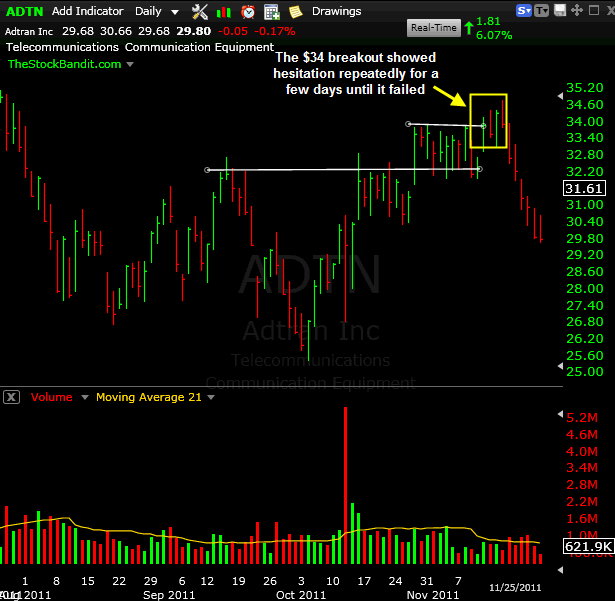
By taking cues from the price action (including failed patterns), it’ll only save you money by way of useful adjustments. Look at those as a courtesy.



Hey Jeff,
Nice discussion. BUT it raises a question or two. I guess, first of all, your ADTN chart pertains to a swing trade. But would you say the same thing for a day trade? That is to say, if you “don’t like the action” on a day trade once it breaks out, would you lighten or even exit before it hits the 1% stop. And when would you raise the stop from the 1%
Hence by way of illustration, your comments on the following would be appreciated. And, I understand that you might say that my analysis below really should only properly be used for a swing trade.
Looking at Tuesday DVA and SHAW:
DVA: Triggered at 75.50. At this point it was above R1 (good) but was pretty extended with a straight up move with little or no consolidation (bad). In hindsight, this could be called a false breakout. Further the volume after the last large up move was less, and the up move was just after the 10:00 econ report. So, I might argue that the sharp reversal, which did not hold at R1 could have been used as an exit even though it was well above the 1% stop. Or perhaps the breakdown after the short consolidation at about 75.10.
SHAW: So SHAW poses a similar issue that resolves differently. It has a nice consolidation at about 24-24.10 after which it rapidly moves up through the trigger at 24.30. Also a straight up move which peaks shortly after 10:00AM and above R2. Using R2 as the raised stop or the failed consolidation at about 24.36 would have locked in a very small gain, but a gain nevertheless vs holding for a 1% stop (which wasn’t reached today). Holding for the 1% stop would have allowed a nice gain at or above R2 later in the day. Perhaps the best strategy would have been to take some off as soon as the initial push above R2 loses momentum or if not then, when the move slightly later back up to the daily high fails and the price moves below the consolidation at 24.47 (slightly above R2).
Thanks….Jon
Hey Jon!
Was out last night with a family member for their birthday so didn’t get a chance to respond to this until now. Since we’re looking backward, hopefully that’s alright!
Yes, I would say the same for a day trade. If you’re getting multiple reasons to think a stock is really hesitating, then there’s nothing wrong with making an adjustment at the very least. Recall with ADTN, it was hesitating to get clear of $34, so I aggressively raised my stop in case those were warning signs. I’m glad I did, it gave me a 1.7% loss on the front end of about a 14% decline.
DVA – Good logic you’re using here, although my stance on it was that 75.50 was such an important level that the trade was still worth taking (even with the stock intraday a bit extended). The econ I would not expect to affect a healthcare stock like this one though. Alternately, an uptrend line intraday could have been used as an exit, which would have resulted in an exit in that same 75.10 area you mentioned.
SHAW – I honestly kept expecting this one to make one last push higher, but it never did. During the afternoon I was using 24.40 as a stop, which was not to lock in a .10 winner but rather just the area on the chart which was holding as intraday support after the morning. Your analysis here is also good though, being that you watch the pivots intraday.
The whole idea I’m trying to convey through these comments as well as the post itself (Think of Your Trades as Employees) is to continually evaluate what the price action is telling you. No 2 trades are exactly alike, so while we can and should implement some fixed rules (ie: a stop for each trade), there’s a feel element to it which is a learned skill. It’s intuition that comes from watching the tape over time, but it helps us make good decisions with regards to stop placement and/or booking profits when the chart suggests it’s best to do so.
What I want is to play the probabilities game with my trades at all times. If it’s looking improbable that this position is going to go further, then I need to adjust.
Hope this helps!