TheStockBandit.com

Swing Trading and momentum investing stock pick newsletter and swing trading service.

  • Home
    • Blog Archives
    • Blog Categories
  • About
    • About The Stock Bandit
    • FAQ
    • Contact Us
  • Strategy
    • Join the Email List!
    • Stock Trading Methodology
    • Trading Rules
    • Chart Patterns
  • Products
    • Products Overview
    • Trading Courses
    • Stock Pick Service
    • Recent Trades
    • Trader Coaching
    • Seminar DVD’s
  • Subscription Info

Think of Your Trades as Employees

November 29, 2011 By Jeff White Filed Under: Trader Development

My ‘Don’t Be a Monkey‘ post prompted some discussion on how to view losses, so I just want to explore that idea a little further. Specifically, Eric commented ‘learn to love loss, and you are on your way.’

Love might not be my chosen word for it, but yeah, that’s the idea. Put it this way…

Last year, we were house hunting with our realtor. When we’d pull up in front of a house that just wasn’t at all our style, we’d offer a preventive “next” to save us all the time of going through a house we just didn’t envision actually buying.

You can’t judge a book by its cover, but some houses you can! Plus, this was a close friend, so he didn’t mind. In fact, he appreciated it. By crossing those no-way houses off our list, it narrowed the search and saved him time.

Couldn’t you view your trades that same way? You could even look at each position as an employee. Poor performance is grounds for dismissal. Take the attitude of “thanks for letting me know you aren’t going to work so I can move on to the next candidate.”

When your trade’s showing you poor price action, don’t get upset. That just might be a gift – a signal to move on to the next idea. No point in getting your feathers ruffled or making it personal. That will only compound your frustration.

Here in the Hideout, I’ve been trading the exact same way. Booking some winners here and losses there, playing the numbers game that trading always is. No single trade carries great importance, but it’s important that losses are viewed properly. A failed breakout or a sluggish move away from a key area means the trade is suspect and may require an adjustment or early exit. I appreciate those warnings from the price action.

And even when in a position, I’m taking note of those subtle changes of character, staying aware of signals the price action may be sending which suggest the trade is struggling.

Recently I entered ADTN upon a breakout attempt at $34, but it just couldn’t stick. A few attempts to clear that level continued to show hesitation, so I tightened my initial stop by 2% on 11/16. I’m glad I did. The stock reversed to stop me out the next day, I booked a tiny 1.7% loss, and moved on to the next trade.
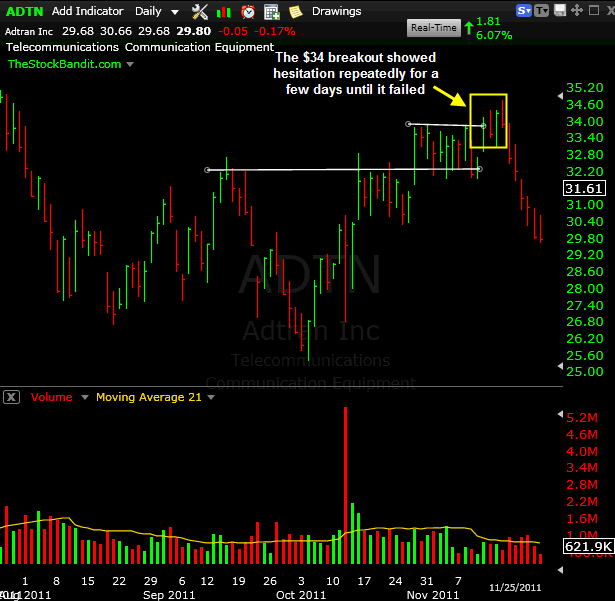
Chart courtesy of TeleChart

By taking cues from the price action (including failed patterns), it’ll only save you money by way of useful adjustments. Look at those as a courtesy.
Trade Like A Bandit!

Jeff

Don’t Be a Monkey

November 17, 2011 By Jeff White Filed Under: Trader Development

Ever seen those monkey traps where they put some bait in a trap, a monkey comes along, sticks its hand through the hole to get the bait, but when making a fist, can’t remove its hand from the trap?
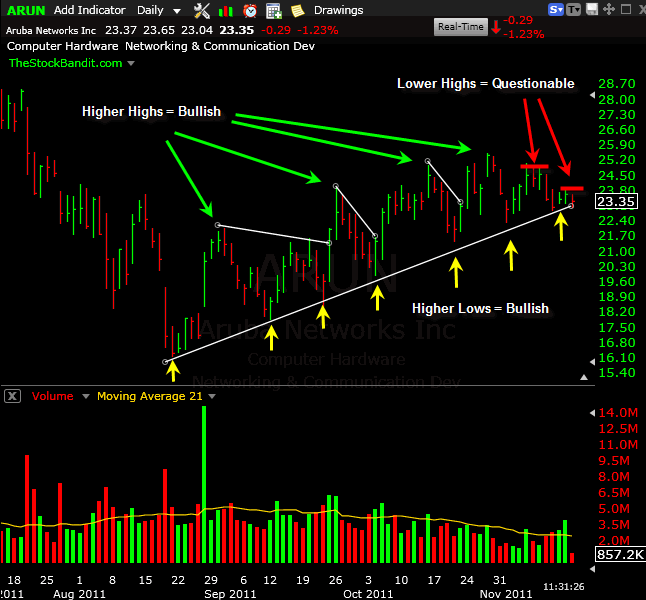

They have to drop the bait in order to escape the trap, but their greed and ignorance prevents them from letting go?

I’ve made some trades in that same manner, and I’m guessing you have too. The ones where I just refused to let go in time because I wanted it to work so badly, and ultimately they proved extra costly.

Dropping the “bait” in those cases would have freed me to go in search of many other, better opportunities, but my short-sightedness prevented it.

Monkey Brained

And while every single one of us has been there at some point in our trading, what’s curious is that it originates not with the setup or a poor strategy or a flawed technique for entering or exiting. It starts with not having a properly prepared mind.

It’s a flaw with our pattern of thinking.

At times it’s based on a fear of scarcity, whereby we stay with a mediocre or poor trade because there’s nothing else on the radar. In effect, we’re bored, in which case we shouldn’t be trading anyway. Listen to the charts!

Other times it’s that our pride is too much on the line and we’re more interested in defending that than our capital. That prevents us from moving on to a truly worthwhile trade, thus keeping us trapped.

Remember the Goal

I’ve talked at length previously about trading as a numbers game, but it’s such a fundamental viewpoint to have as a trader – something we just can’t lose sight of.

Over time, we want lots of at-bats to let our edge play out. When sifting through setups we select actual trades based on probabilities. That’s the aim.

And on any given trade, if we’re keeping that in mind, we’re willing to let go when the feedback we’re getting doesn’t support our original expectation for the play. The price action is weak, a key level fails to hold, or a reversal of direction has begun and the charts are telling you to shut it down – yet you aren’t listening.

Stay on track. Keep the bigger picture in mind. Be willing to lose in this one trade if you need to, so that over the next dozen or hundred or thousand trades you can be profitable.

… In other words,

Trade Like A Bandit – not a monkey!

Jeff

Detecting Subtle Changes of Character

November 15, 2011 By Jeff White Filed Under: Chart Reviews, Trader Development

As traders, it’s imperative that we take note of any nuance or variation from character when reviewing charts. Doing so can give us occasional false or contradicting signals, but it can also alert us to imminent moves or potential pattern failures.

Take for example those imminent move alerts. A sudden perk in volume as a stock turns to challenge a key level can sometimes be an indication that a breach of that zone is about to take place. Someone’s accumulating shares ahead of the break, and technical traders will take note of the volume expansion ahead of a possible break, placing that stock on the radar of many.

Deteriorating Demeanor

Potential pattern failures can also come to light sooner by taking note of variations in how the stock is moving. With that in mind, let’s examine a stock which may be giving off some of these subtle suggestions like I’ve been discussing.

ARUN has a multi-month uptrend line (higher lows) which has provided support on numerous occasions, letting dip-buyers use it as support to play short-term bounces. It’s still intact, but something else is of concern.

Specifically, the stock had been establishing higher highs along the way up, with each bounce attaining new recovery highs – until recently. Over the past couple of weeks, we’ve seen bounces carry to lower levels, and one could even consider drawing a rounded top around the peaks of the past month. This suggests waning strength in the stock, so I’d avoid a support-based buy at this point. ARUN may rally again from this area, but I’m not betting on it.

A New Plan

My inclination would be to give this one a bit more time and see if another descending trend line can be drawn at some point from the 10/27 peak along the recent highs and wait for an upside break. This stock has a history of clearing such trend lines (including the 3 drawn below), so that’s likely a better approach for getting long than a support buy after the establishment of lower highs.

Here’s a closer look at the chart:

Chart courtesy of TeleChart

Again, detecting these subtle variations in the price action is not a guarantee for better entries and exits. What it does is alert us to potential changes of character so we can make better decisions based on probabilities – and trading is all about probabilities.

Trade Like a Bandit!

Jeff

4 Traits of the Perfect Trader

November 3, 2011 By Jeff White Filed Under: Trader Development

Maybe ‘perfect’ isn’t the right word. We can strive for it, but we’ll all fall short of it given enough time. Greatness, though…that’s attainable. But what does it take to become a great trader?
Well, I’m still working toward it myself, and maybe you are too, but we can agree it’s a combination of things. It’s having the ability to walk the line between two sometimes contradicting attitudes or beliefs. Here are a few of those, and I’d love to hear your thoughts on it if you have others to add to the list.

Great traders blend:

A ‘Just Go With It’ Attitude with a ‘Question Everything’ Mindset. What do I mean by that? Well, traders can be a skeptical bunch, but the best traders still act on what they see. A market move might be difficult to trust, but it’s underway and it’s happening with or without you. Traders know they can exit right away if it doesn’t work out, because after all, isn’t that why we trade rather than invest? I recently saw a comment regarding a “real bull market” by a self-proclaimed trader. I find it silly that a trader actually cares. Real traders don’t mind if the moves last or not, they just go with it and adapt along the way.

Flexibility with Structure. Great traders have a game plan in place, which gives them structure or a framework of rules to guide them in the right direction and help them avoid trouble. But they’re also very flexible in how they implement their game plan. They may not deviate from their discipline, but they can shift gears quickly when conditions call for a momentum-based tape or some fade trades when prices are range-bound.

Confidence with Respect for the Market. This is a tough one and in my experience, never completely mastered. Great traders understand risk, and they know the market can take their hard-won capital quickly if they don’t defer to the price action when their timing is off. However, they aren’t afraid to participate, so when they see what they like, they execute with confidence. This might be among the hardest things to get a grip on for a developing trader.

Science with Art. Trading is definitely a science to some (quants, that’s you!), and it’s an art form to others (tape readers, holla!). Some traders develop their own discretionary system whereby they know exactly what they’re looking for but weigh a number of factors before executing. That might mean taking into consideration if the market’s fast or slow, or if there’s a trend or indecision, or how a run ahead of scheduled news might prompt a reversal. Great traders develop a feel (art) through their experience, helping them identify better when to implement the proper strategy (science).

Where do you fit into the mix? Are you out of balance in one or more of these areas? What can you start improving on today?

Trade Like a Bandit!

Jeff White

Market Makers, Specialists, and Stops

October 28, 2011 By Jeff White Filed Under: Trader Development

A Bandit recently asked me:

“Do you believe market makers and specialists really gun for the orders that are on the books that are only a few hundred shares, or do they only search out bigger size?”

Here’s my response:

My take on market makers and specialists is that they just want volume, all day, as they’re selling on the offer and buying on the bid. A few hundred shares here throughout the day add up to a lot. Stocks will naturally gravitate toward key areas of support and resistance, so if they just get close then it’s not that difficult for market makers to ‘spook’ prices a little further and run some stops.

Suppose there’s resistance just a few cents away, they know buy stops reside beyond that level. Flashing a big bid will have shorts quickly covering based upon the quote (which is real by the way), and buyers step in front of it in hopes of catching a run. They can then flip that large order to the ask and it spooks everyone to sell, taking the stock right back down to where it was.

You can see how doing that throughout the day adds to the back-and-forth range-bound type of price action which churns the accounts of retail traders and leaves the stock not necessarily making any big headway.

Also, do not discount the presence of programs doing this exact same thing. If supercomputers can automate the process via algo’s, all the better for the smart money to spook the retail traders out of positions on a regular basis. Head-fake moves which last only long enough to inflict enough pain to prompt an exit is all it takes, so it need not be a lasting move to catch the small trader off guard and separate him from a dime here or a quarter there.

One last thing…

On a trend day when market makers are shorting into strength (selling on the offer during an uptrend ), if they didn’t have a lot of inventory to dump, then they’re getting shorter the higher we go. They will hedge via futures (ES or NQ) or through options. Those derivatives have a huge impact on how the market moves, yet few traders really recognize that.

So when people watch call buying activity or put buying activity in the options, they think they know that someone big is betting on a rise or fall in the shares, but the fact is nobody knows if it’s that simple or if it’s part of a more complicated hedge for a market-neutral position.

It gets cloudy, but there’s my take on market makers and specialists. What’s your opinion?

Trade Like a Bandit!

Jeff

Looking at a Loss the Right Way

October 26, 2011 By Jeff White Filed Under: Trader Development

We all lose here and there, it’s just part of trading. You can’t avoid it, but that isn’t the issue. Where many traders struggle is how to handle a loss gracefully.

Instead if equating a trading loss with personal failure, shift your mentality for what a loss means.

Does it mean you’re stupid? Not necessarily.
Does it mean you were wrong? Yes, in at least one way.
Does that mean you will never get it back? Absolutely not.

Losses are an event, yes, but it’s also a distribution from your account. Consider them a cost of doing business as a trader. Brick-and-mortar stores have overhead, but as a trader, the biggest portion of your overhead is the losses you take.

When businesses cut costs, they’re reducing their overhead as much as possible to fatten their profit margins. Do the same with your trading. Reduce your ‘loss overhead’ by accepting a loss quickly and moving on to the next trade.

It’s much more fun to always be adding to your account rather than seeing funds flow out, but as soon as you start viewing trading losses as something impersonal, it’s going to change your perspective in a very helpful way. Rather than fret over them and allow losses to cloud your thinking or alter your mood, viewing them through the proper lens will help you more quickly get them back and then some.

Like it or not, trading is a business…how are you managing yours?

Trade Like a Bandit!

Jeff

Spooked By the Past

October 18, 2011 By Jeff White Filed Under: Trader Development

Traders are a skittish bunch. We can make the same trade 100 times, but the one time a left-field event occurs, it can spook us forever.

The other night, I let the dog outside before bedtime. He’s a 7-year old Boston Terrier, so I’ve done that literally a couple thousand times. This time, however, he returned to the porch with an unusual look. I knew what happened before I even opened the door, because I could smell it…he’d been sprayed by a skunk.

An hour later after thoroughly bathing him outside, our house still reeked – despite not letting him in until he’d been bathed. And let me just say, fresh skunk spray smells nothing like roadkill skunk. It’s WAY worse.

Thankfully, the stench is long gone now, but that single event conditioned me, and I’m concerned now when I let him out every night…all because of that one awful experience! Doesn’t seem right, does it?

Spooked By The Past

In trading, we have to remind ourselves regularly to remain in the present tense. Because this setup burned you last time doesn’t mean it will this time. Maybe your first couple of trades of the day were losses, and now you’re scared to touch another trade. Or perhaps you’re coming off a tough few months and you’re afraid to get back in the mix.

While respect for the market and quality risk management are of utmost importance, what I’m referring to here is the crippling fear that’s costing you. It’s the fear that’s preventing you from elevating your performance, or from digging out of what should be a manageable hole. It’s the kind of fear that has you paralyzed and unable to pull the trigger on anything.

Return to Trading Confidently

Here are 3 Ways to Overcome Your Fear of the Past:

1. Understand your odds for success. This of course includes an honest risk assessment of the play, but it also means knowing whether this type of play is likely to work given the conditions. Going over your results consistently will reveal which kinds of plays are working in the current environment and which are more likely to fail. If you understand your odds for success and you’re able to have some mathematical confidence, it would be more costly to skip the trade.

2. Understand failure. Knowing the worst-case outcome if this trade happens to fail can reduce the fear inflicted by a previous failure from an unseen event. Black swan events aren’t common, so it’s not reasonable to fear them every time you approach a setup. Weigh the potential for loss, and if it’s outweighed by the potential for gain, the probabilities are favorable enough to participate.

3. Choose to move forward. All of us have the ability to choose, whether it’s our career or our spouse or our attitude. Maybe your fear somehow gives you comfort right now, because it’s been a habit you’ve allowed. That won’t cut it though, so it’s time to change. Eventually, you either decide to get back on the right path, or you’re completely done trading. Make your choice and get on with it – and don’t look back.

Don’t let the past haunt you into skipping potentially solid plays. Assess your risk, and then take the trade confident that over time, the numbers will work to your advantage.

Trade Like a Bandit!

Jeff

  • « Previous Page
  • 1
  • 2
  • 3
  • 4

Recommended Broker


Links

Terms of Service
Privacy Policy
Disclaimer
Site Map
Contact us

Follow


Premium Services

Stock Pick Service
Trading Courses
Trader Coaching

Copyright © 2026 TheStockBandit, Inc. ยท All Rights Reserved